A BOOK BY RUI PEDRO DUARTE

AI can do more.
Who gets the
last word?

The future will be shaped by what we delegate.
And by what we choose to keep.

The Human Reserve makes the case for a new social contract: one that puts human judgment, rights and responsibility at the centre of the AI era.

Step inside the book

THE HUMAN RESERVE · A NEW SOCIAL CONTRACT FOR THE AI ERA

A place for the human.
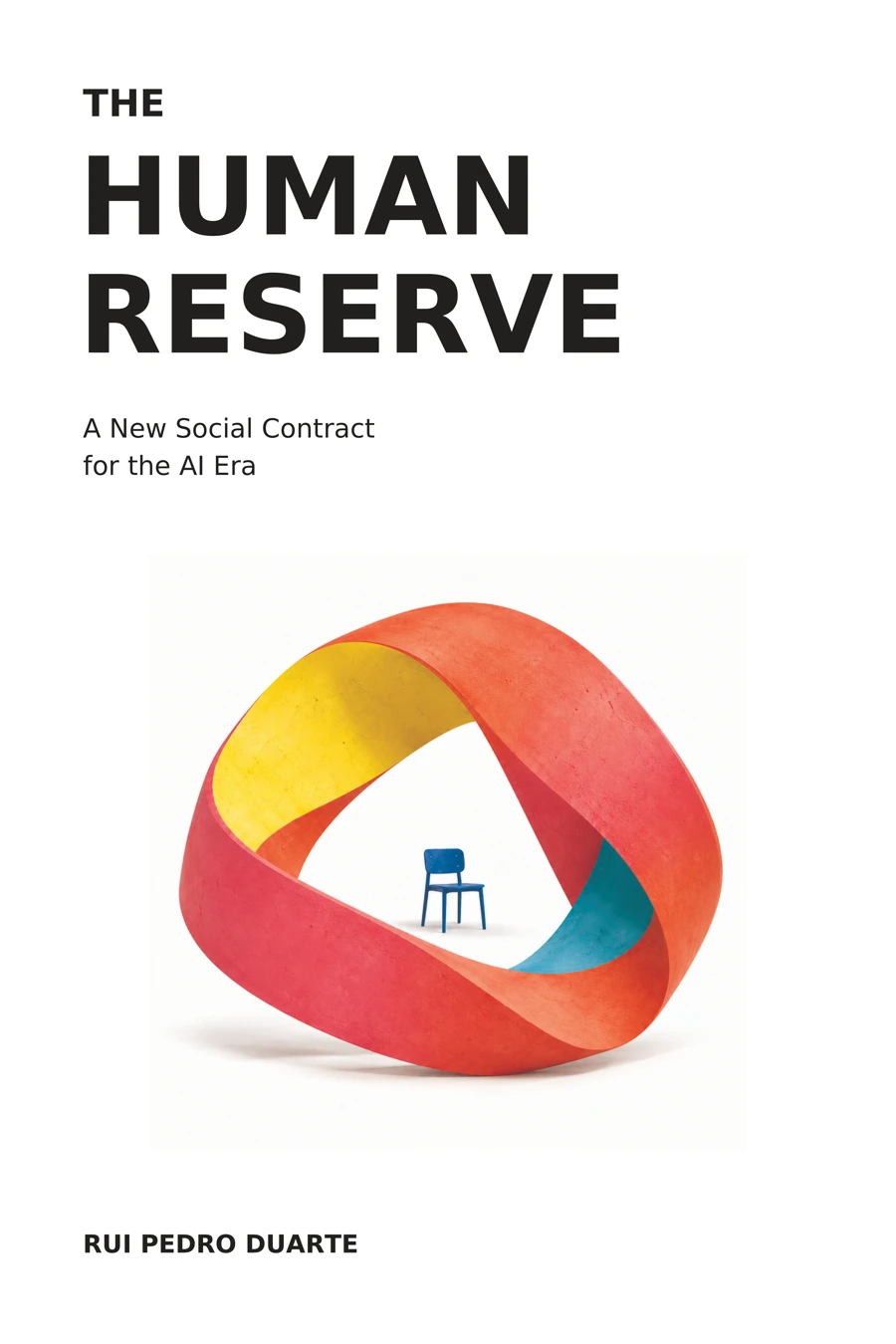
The Human Reserve book cover: a colourful impossible loop surrounds a small blue chair on a white backdrop
HUMAN AUTHORITY.
BY DESIGN.
A philosophical argument.
A practical commitment.
18 chapters7 practical appendices1 question that changes everything

We can delegate a task.
Can we delegate
the responsibility?

Picture a decision that matters to you. A job. A public benefit. A medical appointment. A system has given its answer. One detail is wrong.

Now try to find the person who can change it.

That is where this book begins. As AI becomes more capable, our institutions need more than a reassuring promise that a human is involved. People need the knowledge, time and authority to question a decision and the power to act.

The Human Reserve is the capacity we choose to protect.

“Who can change
this decision?”THE QUESTION AT THE HEART OF THE BOOK

A human place.
At every scale.

The argument starts in the everyday work of organisations. It reaches the rights we hold together.

01

The organisation

Who is answerable when AI acts? Explore the Chief Human Officer: a role with a mandate across departments to govern delegation, verification and intervention.

THE CHIEF HUMAN OFFICER · THE HUMAN CONSTITUTION
02

The citizen

Our data, work and public services are becoming part of an automated world. What voice do we retain? And who shares in the time and value AI creates?

DATA RIGHTS · PUBLIC SERVICES · THE TIME DIVIDEND
03

The world we share

The cloud has a postcode. Computing uses land, water and energy. Its benefits and burdens belong in a social contract that also protects a human decision of last resort.

SUSTAINABLE COMPUTING · CONSTITUTIONAL RIGHTS

A compass.
A mandate.
A way to act.

An ethical commitment needs a place in the work. The book turns its philosophy into blueprints for organisations: a model constitution, a Chief Human Officer mandate, a delegation map and a proposed constitutional clause.

At the centre is the Human Governance Compass—an adaptation inspired by AI2030’s six-pillar framework, with human authority connecting every commitment.

Explore what’s inside
THE HUMAN GOVERNANCE COMPASS
ProtectionAnswerabilityUnderstandability
and challenge
HUMAN AUTHORITY
Agency
and privacy
JusticeStewardship
Purpose · Permission · Verification
Intervention · Remedy

From a question
at the kitchen table
to a new social contract.

Five parts. Eighteen chapters. A continuous argument about what it means to remain responsible in a world of intelligent systems.

OPEN A PART TO EXPLORE THE CHAPTERS
I

The Future Needs an Author

  1. Before We Automate, What Are We Building?
  2. The Difference Between an Answer and a Judgment
  3. The Human Reserve
II

The Organisation With a Human Constitution

  1. Put AI Inside the Human Mandate
  2. The Chief Human Officer
  3. A Constitution Before a Deployment
  4. Six Commitments, One Human Spine
  5. When Delegation Becomes Abdication
III

Citizens, Not Just Users

  1. Citizenship Beyond the Terms and Conditions
  2. Your Data, Your Voice
  3. Who Gets the Time We Save?
  4. A Public Service Must Have Someone Behind the Door
IV

The Cloud Has a Postcode

  1. The Neighbours of Intelligence
  2. The Right to Sustainable Computing
  3. A Commons We Can Govern
V

From the Company Charter to the Constitution

  1. Rights That Survive the Next Upgrade
  2. Greece Opens the Door, Portugal Enters the Debate
  3. The Human Last Word

Plus a prologue, an epilogue, seven practical appendices and sources and notes.

Imagine receiving a message on an ordinary Tuesday morning. Your application has been refused.

You read it at the kitchen table, with a cup of coffee cooling beside you. The decision concerns support you were counting on while caring for someone in your family. There is a reference number, a paragraph about eligibility and a link to further information. You follow it. The page explains the process in language that seems reasonable until you try to connect it to your own life.

One detail is wrong. Your circumstances changed two months ago. You supplied the document. You can still see the confirmation email.

You open the help window and explain. A reply arrives immediately, politely directing you to the eligibility criteria. You explain again, this time with the date and the document number. Another reply offers to guide you through a new application.

You look for someone who can reopen the existing one.

AN EXCERPT FROM THE HUMAN RESERVE

A small blue chair at the centre of a colourful impossible loopKeep a place for judgment.

POLITICS · TECHNOLOGY · HUMAN AUTHORITY

Rui Pedro Duarte

Rui Pedro Duarte is an AI governance adviser, executive and educator whose work connects technology, public policy and diplomacy.

He is Managing Director of Loop Future Switzerland (DACH), a former Member of the Portuguese Parliament and a member of AI2030’s Global Advisory Council. He teaches ethics, AI and diplomacy on the UNITAR programme in Geneva and Applied Agentic AI for Leaders at Coimbra School of Management, University of Coimbra.

He holds a master’s degree in political economy from the London School of Economics and Political Science and a bachelor’s degree in international relations from the University of Coimbra.

His previous book, Statecraft 3.0: The Age of AI Diplomacy, argued for a global constitution of international order. The Human Reserve continues the inquiry into the institutions we need for the AI era.

Explore the author’s work

THE HUMAN RESERVE

The future needs
an author.

What will we choose to keep?

Begin with the opening

Paperback edition · 216 pages
Amazon purchase link will be added when the book is published.